


“I was shifted to full-back in 1971,” recalled Clay.
“It’s funny; I was sitting at the kitchen table with my old man, reading the paper, going through the side. I looked at the centreline and my name wasn’t there and I thought, ‘Oh, stuff it,’ and I passed the paper to my old man.
“He said, ‘Oh, you’re at full-back,’ and I thought, ‘What?’ That was it; no one told me.
“Right away I rang Fred Swift (1967 premiership captain and full-back) and asked, ‘What do I do here, Fred?’ because, although I knew what a full-back did, I was giving both height and weight away to blokes like (Peter) Hudson and (Doug) Wade. But they knew I could kick the ball, so the thinking was that I’ll kick out from full-back and hit the middle of the ground.
“I played six seasons on the wing and another five at full-back, so it probably saved my career.
“If anything, I was more conscientious playing there, because if you missed a ball on the wing, you’d always get another chance. At full-back, you miss it and you’ve conceded a goal and there’s a black mark . . .
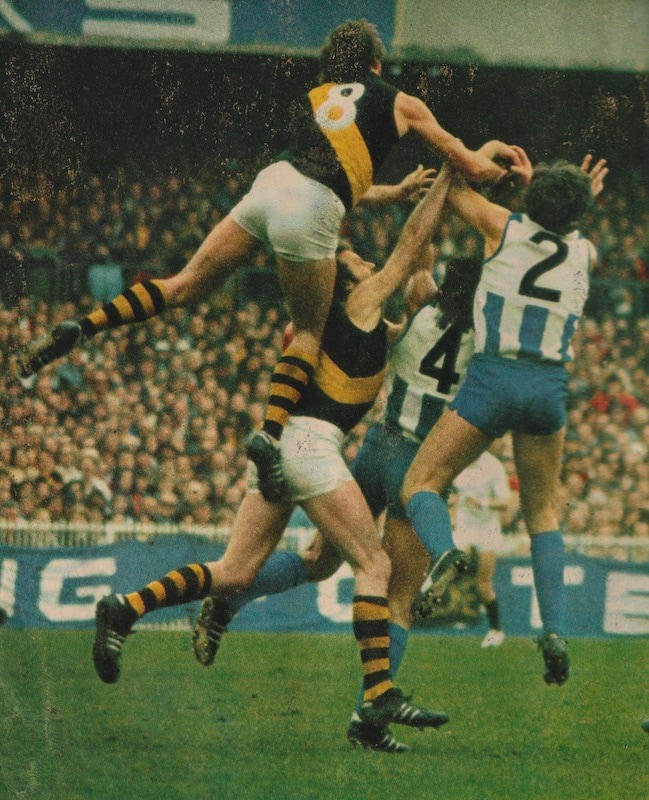
“There were some pretty handy full-forwards going around, like Hudson, (Peter) McKenna, Wade and (Alex) Jesaulenko, but it’s no good getting overawed.
“I was a wingman’s height and stood 6’1’’ (six feet, one inch or 185cm) and some of the full-forwards were up to 6’3’’ (190cm), so into the gym I went, to put on some beef, but I still had to rely on spoiling tactics rather than pushing and shoving.
“I took the approach, I’m here and they haven’t beaten me yet, so I’ll do whatever it takes to beat them. I would spoil, tread on their toes and do whatever it took to not concede.”
In an interview with The Herald newspaper several years after his retirement, Clay revealed that he preferred the pressure associated with the key defensive post, rather than the relative freedom of the wing.
“At full-back I became a more responsible player and I enjoyed it,” he said.
“I enjoyed the weekly battles; the game-to-game responsibility.
“A dash along the wing on the MCG caught the eye. If I curbed a good full-forward only my club and astute critics noticed. Full-backs don’t get much publicity . . . that never worried me.”