


Doug Searl, the visionary junior football coach who led the Richmond Under 19s to the 1985 and 1989 premierships, has died. He was 79.
Searl died Sunday, May 10th 2026, his lifelong friend Ken Dyer told Rhett Bartlett.
Prior to coaching, Searl played 12 games for Collingwood from 1966-1968, including the nail-biting Grand Final loss in his first season, then 131 games (kicking 170 goals) with Fitzroy from 1968 to 1976.
At Tigerland, he guided our Under 19s to Grand Final appearances in 1984, 1985, 1987 and 1989 - all against Denis Pagan’s North Melbourne.
In 2021 he spoke about his influential football career in a rare interview with Bartlett, detailing what made him so successful.
“I think really, it’s the players," Searl said. "Particularly if they have the respect and show that to the coach. I don’t think I was much more than a second father. I think it was important they just believed in what I was saying, in the hope I could help them out along the way; that they might improve. You need a lot of people around you to do the right thing to support the kids.”
His influence on the Tiger cubs was evident in the number of U19 premiership players who made it to the Seniors. From the 1985 flag there are no few than 10 - Des Ryan, Brendon Bower, Dean Notting, Justin Pickering, Allan McKellar, Chris Pym, Jeff Hogg, Simon Clark, Craig Smith, and Mark McLeod.
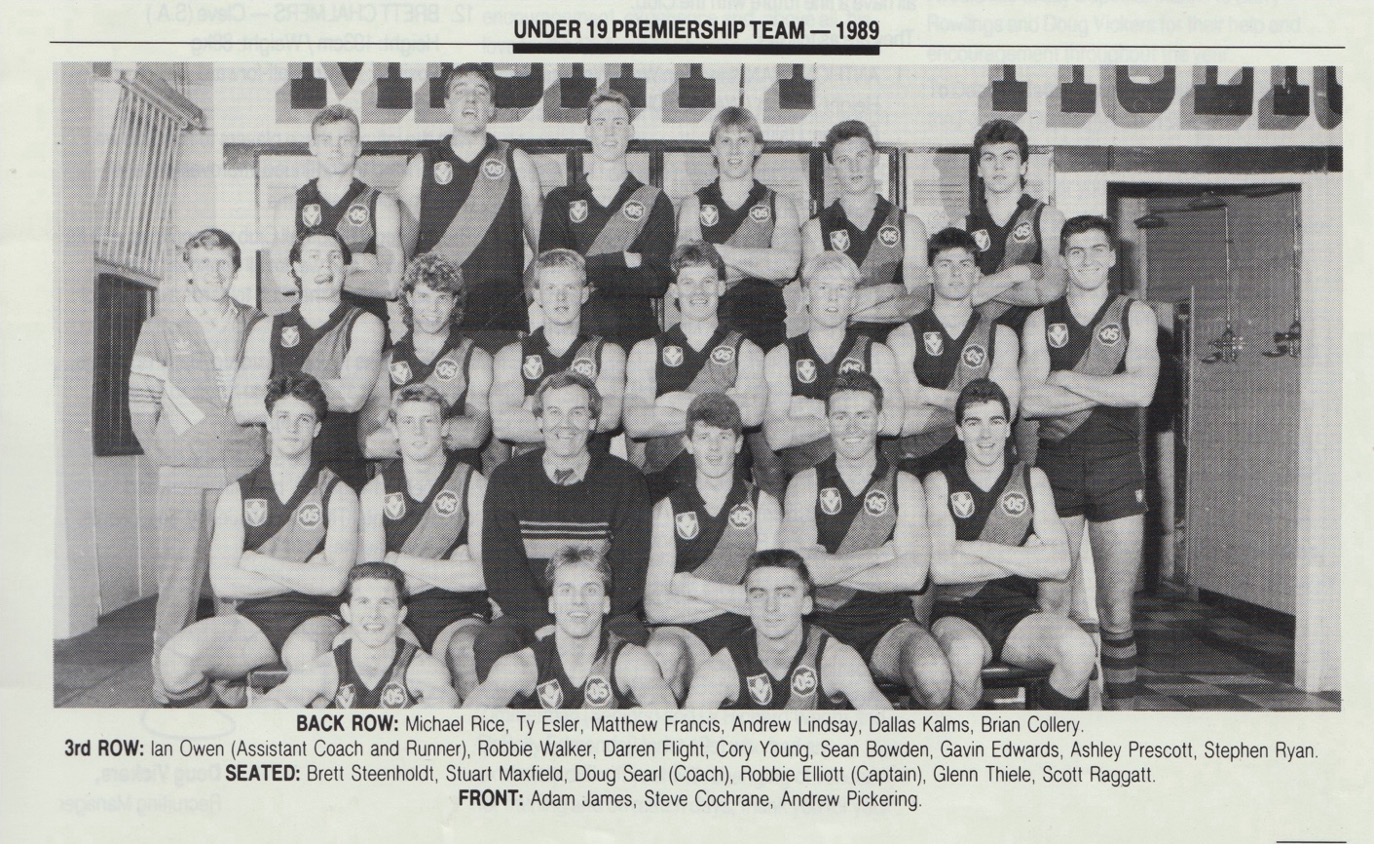
In the 1989 flag, seven went on to the big league - Robbie Walker, Stuart Maxfield, Stephen Ryan, Cory Young, Sean Bowden, Matthew Francis, and Ty Esler. On top of that, Searl also coached Tony Free, Craig Lambert, Matthew Knights, Trent Nichols and Barry Young.
“When I started working with the young kids it was a great time of my life. Somebody asked me once, what was more important, playing or coaching, and I actually said coaching,” Searl said.
Born Douglas Roderick James Searl on March 22nd 1947, his father Sid played for Port Melbourne in 1941, 45-48, and Richmond in 1942.
In 1953, however, he left the marriage and moved to Western Australia, leaving Searl and his mother to live in a flat opposite the Punt Road Ground.
“He wrote a letter to me in 1966, saying that he saw me play in the Second Semi-Final. He said ‘you’ve done pretty good, though your game in the Grand Final wasn’t the best. I need you to go and do some running, get some leg speed.’ That’s the only thing I received from my father unfortunately, but that’s the way it goes,” Searl said.
Searl played junior football at East Melbourne YCW, captained the Collingwood Tech cricket team (he couldn’t get a game in their footy side), later played district cricket for Collingwood before joining the Carringbush in the Under 19s footy team.
It was at that time that senior coach Bob Rose gave him an ultimate to stick to football or follow his cricketing passion to England with Keith Stackpole’s family.
His interest in coaching juniors came from his Fitzroy mentor Bill Stephen, who saw something in the then 30-year-old.
“I had no confidence in my ability to do that. Unfortunately, as a player I was that way at times. I didn’t believe I could do the things I could do if I had the right attitude,” Searl said.
Searl took the Fitzroy U19s to the 1977 and 1980 Grand Final losses (both against Richmond), before finally nabbing the flag in 1982.
At the end of 1983 he remembered speaking with the hierarchy about the salary for the following year, was unhappy with the outcome, and simply walked out.
“No sooner had I got home that my wife was singing out of the window ‘Richmond are on the phone!’, it was Kevin Dixon, who had been at Fitzroy with me. I couldn’t believe it; I was really upset leaving Fitzroy. I had a wonderful time with the players as their coach," Searl said.
In his debut season at Tigerland he won 20 games and lost five, including the Grand Final.
“The word got around that I was going to be tough, and the whole pre-season I never said a word, we just trained and I was quiet as hell. I have got a bit of a temper at times,” Searl said.
His third match as coach saw him face up against his old chargers at Fitzroy and he was adamant his Tiger boys were more skilful. At half time with things not going great, he remembered kicking a table of drinks onto a player standing beside him, then punching the lockers. It jolted the team into action and Richmond triumphed by 49 points.
After the 1985 premiership he sensationally left Tigerland to return to Fitzroy as an Assistant Coach under David Parkin, before returning in 1987.
He nearly snagged another premiership that season after Richmond came back from seven goals down at three-quarter time, to only lose by five points in the Grand Final. The infamous last quarter went only 26 minutes, when the siren sounded, apparently, two minutes early. Richmond lodged a complaint, but accepted the result.
The 1989 premiership would be Searl’s last, but proved once again what a master tactician he was. He recalled sitting out the front of Waverley Park with his wife Jennifer on the morning of the match, as the trophy arrived at the ground.
The Tigers had been thrashed by 80 points to North Melbourne in the Second Semi-Final and Searl confided that “we can’t win this game unless I can get the players to basically play one-on-one”. His plan worked. Pagan began dragging players from the ground as he saw they were being tightly tagged and it upset their rhythm. Richmond won by 45 points.
“I can’t ask for a better time at Richmond...except the last year," Searl said.
"Unfortunately, in 1990 I happened to walk in to the club and there was a lot of people sitting in an office and I was hammered by them saying that I wasn’t letting players go forward. I thought 'excuse me!' there was about 17 players training out on the ground that came through the Under 19s.”
He was told he would need to re-apply for the position, and upon hearing criticism towards his assistant coach Ian Owen, decided then and there to quit.
Searl would go to the VFA and coach Port Melbourne from 1991 – 1992, ably assisted by his Reserves coach Neil Ross.
"Doug was a coach who loved his players and they knew it. But he was hard and set high standards,” Ross told Rhett Bartlett.
“A great tactician with a modern football brain. A great motivator, he made teams feel like they could beat anyone. Strong willed, with a heart of gold. He will be sadly missed.”
Off the field Searl battled serious health issues including a Leukemia diagnosis 24 years ago, and suffered five heart attacks.
“I was given 3-5 years to live but I’ve been going 25 years,” Searl said in 2021.
Survivors include his wife Jenny who volunteered at Tigerland as the video photographer during his tenure as coach, and helped with raffles and fundraising at the Save Our Skin rallies.
The Richmond Football Club send their condolences to his family, friends, and the hundreds of junior players who adored him.